Creosote – The Aroma of Rain

Creosote Bush aka Greasewood
Larrea tridentata

The wonderful experience of a storm in the desert includes the stark beauty of valleys and mountains, diamond raindrops, intense rainbows, wind and an unforgettable aroma that fills the air after the storm passes causing us to reflect that “the desert smells like rain.” This is the scent of Creosote Bush.

Found throughout the warm North and South American deserts, Larrea is a plant of contradictions — a poisonous plant, although jackrabbits are known to sharpen their teeth on it; and a source of medicine and food for humans. Extracts of the leaves are used to treat sores, but touching the leaves can give some people dermatitis. The flower buds are pickled in Mexico and eaten like capers. Deposits left on stems by lac scale insects (Tachardiella) can be used as glue or a waterproof sealant.

Three non-interbreeding ecotypes of Creosote Bush occur in North America. An ecotype is a regionally or locally adapted form of a species. The Chihuahuan form is upright and vase-shaped, with few leaves near the base. The branches terminate in flat fans of leaves which tend to be fewer in number, but larger than those of the other ecotypes. The other two ecotypes are derived from the Chihuahuan form. The Sonoran Desert creosote bush is upright, but broader than the Chihuahuan and with more branching and leaves low on the plant. The Mohave Desert ecotype is lower, bushier and likely the result of a rare sterile hybrid between the other two ecotypes. The strong genetic barrier between ecotypes suggests that these really should be considered separate species. The problem is in identifying which ecotype/species is being studied since they look so similar.

Creosote is generally found below 4,000 feet elevation, and in the hottest, driest localities.  Flowering normally occurs in spring, but may occur almost any time of the year following substantial rainfall. Flowers are yellow with five petals and about ¾” across. The leaves are formed by two branched leaflets, about 3/8” long, which are joined at the base. The leaflets create a natural water drop catcher and aid in leaf uptake of rainfall. The leaves are resinous and emit a distinctive easily recognized smell.

In the landscape, plants may be used as medium shrubs, open screens, or as a clipped hedge and placement in arid or transitional zones is appropriate. The Creosote Bush is also desirable for its scent and colorful blossoms. Plants are sporadically available in nurseries, salvaged or grown from seed. When planting Larrea, it is important to take extreme care not to break the root ball, as this is often fatal to the plant. Cutting the pot, then carefully lifting the plant out and into the hole is recommended. Newly planted creosote bushes should receive sufficient watering for 1-2 years, after which rainfall alone is generally adequate.

Bloom Watch #7 – Closer Than Ever!

Finally, most of the flowers are on the move. It appears that something in the storm event on the July 11 woke her up. As I said before, I don’t believe it is the rain itself that is the trigger. I had four stalls in my greenhouse that didn’t get any rain, but did experience the other storm factors and are on the move with the rest. Two of the first buds to reach stall are still stalled along with several others. There is a group in the 60-80 mm range, which with a little luck will all go on the same night. The Queen continues to be obstinate with a group of flowers still in the 30-50 mm range. Last week I told you that she made a new bud, and this week that bud is 60 mm and should bloom with the others. Pretty impressive to go from start to bloom in only two weeks.

The Queen’s court is also becoming active. The P. fosterianus buds are on the move, the P. oaxacensis has five new buds that appear to be going straight to bloom, and the P. striatus has three developing buds. In my experience the P. striatus typically blooms in August, but I will be sure get pictures when they do and send them along. Maybe some will even go on Bloom Night.

Bloom Night is coming, so stay tuned for the call of the Queen. Many years of data and observation suggest that 60 mm blooms are five to six days out and 80 mm could be four to five days out. My best guess is that Bloom Night might occur somewhere between this Sunday, July 16 and next Wednesday, July 19. This is only a guess, as she has been known to do whatever she wants. My friend has two buds that have been at 80 mm for over a week now.

The number of flowers won’t be as large as in previous years, but will still be beautiful and fun. Besides, Bloom Night is the only time I get to see so many of you and the Queen and I will miss you if you can’t make it. See you soon.

Until Next Time – Lee Mason, Director of General Services, Tohono Chul

August Means Arizona Poppies

One does not normally think of the desert blooming in the summertime, since most of the showy annuals we are familiar with appear in the spring. However, the Arizona Poppy (which is not actually a poppy) is a striking exception, usually blooming after the start of the summer rains, July through September. The bright orange flowers (1”-3”) are veined with red and can sometimes rival a display of Mexican Gold Poppies. Plants can reach 3”-5” across and up to 1 ½” tall and may be found throughout the lower elevations of Southwestern North America.

Lacking any fragrance, pollinators still find the flowers most attractive, particularly our native bees, but wasps, flies and butterflies will also partake of the nectar and pollen on offer. Naturalist David B. Williams writes:

“The great variety of visitors utilize the flowers in four distinct ways. Unlike many insect visitors to plants, three groups do not play a role in pollination. One group avoids the anthers and stigma by being too small. A second group, including honeybees and larger wasps, extract nectar from under the flower. A third clan only stops by for nectar. A fourth group gathers pollen and nectar from within the flower and contributes to both cross- and self-pollination. Researchers hypothesized that the non-pollinating visitors ‘contributed to the economy of the plant by reducing the quantity of available nectar so that the pollinators have to visit more flowers to get their full nectar supply’.”

The resulting seeds are an important food source for doves and quail.

Caltrops are so named because the fruits of many of the species are shaped like military caltrops, pointy metal objects designed to be strewn in the path of advancing troops to impede their progress by injuring the feet of men or horses, in the case of the cavalry, by puncturing a vehicle’s tires today. Other members of the caltrop family include creosote bush and the introduced European Puncture Vine, also known as Goat-head because the seeds resemble the horned head of a goat. Puncture Vine is a common summer weed in lawns and disturbed areas, an extremely obnoxious plant with the capability of poking holes in flip-flopped feet, or even puncturing a tire. Its well-earned scientific name is Tribulus terrestris — scourge of the earth!

Look for Arizona Poppy along the roadside up and down Oracle Road, north to the Junction. The best viewing should be late summer (August through early September), assuming sufficient summer rainfall.

Bloom Watch #6 – Will Bloom Night Ever Happen?

Well here we go again. The Queen is doing everything she can to aggravate me and doing an excellent job at it. During this last week five plants decided they didn’t have the reserves to support flowers and we lost seven more buds. On the upside, she made one new bud, the latest start of a flower that I can remember.

The flowers continue to go just a few at a time, which is driving me crazy.
Blooming Progress:

June 27 – 1 bloom
June 28 – 1 bloom
July 3 –  1 bloom
July 4 – 14 blooms
July 5 – 1 bloom

That’s 34 flowers so far this year. Some of the Queens are named as you know. Their names come from either the person who found them, a particular trait, or where they came from. Some of the ones that have bloomed are Howard, Theodore, Peridot, Pipeline, Early Bird and Christina. There are still a good number in stall. My hope is that they quit this sporadic show of defiance and go together. If so, it will still be a good show and a lot of fun.

Jessie at the Pima County Native Plant Nursery said that hers are also going sporadically. People I know in the Vail area tell me that they are sharing the same experience. We are all looking for a break in the weather and hoping for a good bloom soon. It won’t however be this weekend, so keep reading and I will keep watching her for a positive sign that Bloom Night is here.

As for the Queen’s court, there were five flowers that opened on the P. tepalcatepecanus and the next two on the P. oaxacensis. The P. fosterianus is still just sitting there trying to figure out when the best time would be to catch me unaware. Below are some pictures of the flowers. The first two pictures are of the P. tepalcatepecanus and the next two are the P. oaxacensis the last two are P. greggii or “Peridot” from last night.

Until Next Time – Lee Mason, Director of General Services, Tohono Chul

Bloom Watch #5 – Keeping Us Captivated

I just got back from talking with the Queen and she is displaying her usual attitude. She has let me know that Bloom Night will happen when she is darn, good and ready. One flower will bloom tonight and another tomorrow, with the rest of the holding buds still in stall status.

I believe she is showing some stress from this extensive heat, because even with her desert fortitude, she has decided to cut her losses and let four buds go. Even with supplemental watering it is getting the best of her. I was hoping that the threat of storms earlier this week would help make up her mind, however it didn’t happen. I have long thought the stall break was attached to a storm event, but have not been able to pin down exactly what in the storm itself triggers the move. I ordered some new test equipment to more closely monitor all the weather conditions as potential trigger factors. As I have talked about before, it has to be a combination of weather-related factors. It is unlikely that the water from the storm is the trigger or ours would have already bloomed, as we soak the plants twice a week this time of year. So when the new test equipment comes, we will start a new round of data collection.

As for the rest of the Queens court, two flowers will go tomorrow on the P. tepalcatepecanus and several more appear to be on the move. The P. oaxacensis has one very close and another on the move. I’m not sure of the size of the bloom as this will be my first time seeing it. The P. fosterianus is also a mystery. The bud bases appear to be getting larger, but the flower portion is still small. It might be the way she does it, I’m not sure, but will know after this year. I will get pictures and send them along next week.

Right now it appears that Bloom Night will slip into July, but keep watching as sometimes she likes to show me she is still in charge.

Until Next Time – Lee Mason, Director of General Services, Tohono Chul

Bloom Watch #4 – Almost, But Not Quite

It’s been a good week! The two I mentioned in last week’s Bloom Watch went, one bud on June 8 and other on June 10. The majority are still in stall and the small ones are trying to catch up. This is the time when she begins to do it her way, and if I’m not on my game she will do something behind my back. I’m confident enough right now though to take today off. I didn’t tell her as I don’t want her to have a plan. I will check tomorrow to see if I got away with it or if she has started to make her move. At any rate, she can’t get there before next week at the earliest.

In an effort to find out what triggers the stall break I’ve been watching the weather and we have run the full spectrum of analyses. The temperatures were hot then cooled off, the humidity went up and then down, and still no major movement. The forecast shows we are set for another sharp increase in temperature, so we’ll see.

The P. fosterianus, P. tepalcatpecanus, and P. oaxacensis are still holding, although it appears that one of the tepalcatepecanus buds is on the move as of yesterday afternoon.

More information to come soon, so stay tuned as I will make the announcement once she finally whispers, “I am ready to move forward”. Until then, stay cool and start gathering your hiking boots and flashlights.

Until Next Time – Lee Mason, Director of General Services, Tohono Chul

Bloom Watch #3 – A Few Bloomed Too Soon

Sorry for the delay in this update I’ve been busier than a one armed paper hanger. I have however been making daily checks on the Queen and she is up to her old tricks.

Since my last update there have been 7 flowers and will likely be 2 more within the next week. The ones I told you were at stall size last time never stalled, but just went straight to bloom. It has been a while since I have seen that, but she did it because I wasn’t checking every day and wanted to get me. I caught her and have been checking every day since and now she is behaving herself. There are a bunch of buds in stall status and quite a few small ones left to go. Hope the stalls just wait for the smalls.

I’ve been watching the P. fosterianus and the P. tepalcatepecanus for their bloom, but both are still holding. The buds on both of those are very slow growing and because this will be the first bloom of the P. fosterianus for me I’m not sure how big they will get. I did notice last Friday that the P. oaxacensis is starting to bud up. This will be another first timer for me. Maybe they will hold for Bloom Night.

You will hear from me next week unless something really unexpected happens. I don’t believe they can get there before next week even if they start now.

Until Next Time – Lee Mason, Director of General Services, Tohono Chul

Devil’s Claw or the Unicorn Plant

During the summer rainy period rather large, succulent, sticky plants are found along the floodplains and channels of arroyos throughout the Sonoran Desert. These plants have a long history of use as food and fiber by native peoples. The fruit, known as devil’s claw or in the Tohono O’odham language as “i:huk,” is cooked and eaten when young and tender as are its tasty, oily seeds. The claws are used for basket fibers, the fiber splints being very durable. I have seen baskets used in households and for feasts that have lasted for 100 years without the bottom wearing out. The color of the splints can be white, yellow, black or grey, depending on when the fruit is picked and how it is cured. The preferred red-black color is obtained by picking the fruit while it is green but when its internal fibers begin to stiffen. Waiting too long to pick the fruit results in a hard grey fiber.

Proboscidea parviflora was domesticated in the northern Sonoran Desert, probably by the Hohokam more than a thousand years ago; basketry containing Devil’s Claw has been dated to 600AD. The domesticated form has white seeds and large, long claws up to 12 inches, with three or four claws per fruit instead of two. The wild plants have claws 3-5 inches long and black seeds.

Plants of the genus Proboscidea are found throughout much of North and Central America and northern South America. All have flared tubular flowers and the distinctive horned fruit. Another local species, P. altheafolia, is a root perennial with larger yellow and orange flowers and a smaller fruit than P. parviflora, an annual with cream-burgundy flowers.

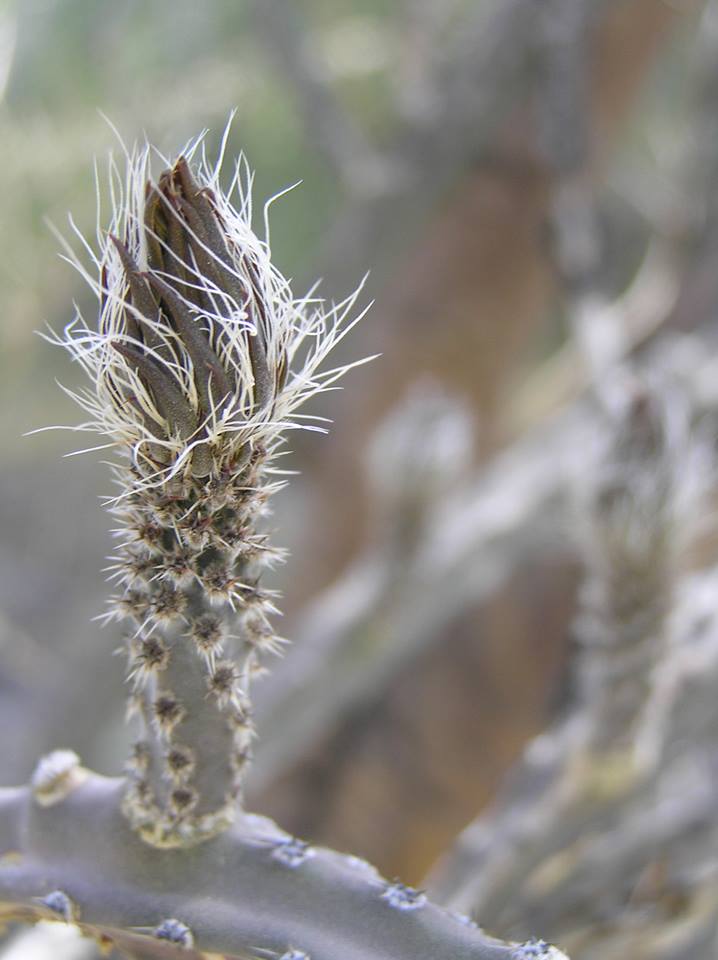
Another plant that is closely related to and probably ancestral to Devil’s Claw grows in Mexico and Central America. Martynia annua has a fruit about an inch long with little hooks growing out of its bottom. The fruit acts as a tickseed in animal hair or skin. It takes little imagination to see the fruit enlarging and growing longer hooks until it has become today’s Devil’s Claw. The larger hooks are better grabbers and hook easily onto animal legs and to human feet and ankles. The springy claws help transmit and amplify vibrations to assist the rough seeds out of the woody fruit as the animal moves about.

Devil’s Claw is a heat-loving plant, tropical in origin that likes water but is drought tolerant. In order to grow i:huk in our area, plant seeds about an inch deep between April and September 1. Adequate water will produce more and larger claws, but plants will survive with minimal water once established.

To find wild Devil’s Claws, walk along the banks and bottoms or washes; for the domesticated variety, check out the Ethnobotanical and Sin Agua Gardens here at Tohono Chul.

Bloom Watch #2 – Peniocereus Progress

The Queen has been busy over the last couple of weeks and there are now three buds at stall size. It will be interesting to see if they hang on for the others or if they just take off on their own. Many of the plants are still recovering from last year’s onslaught of the fuzzy and cute little pack-rats. The population has seen a decrease, but there are still a bunch around. Hopefully the pack-rats won’t be as big of a problem this year.

Those of you who came to Bloom Night last year will remember the collection of 11 of the 21 species of Peniocereus. With some help from a friend, we now have 13! Of those the P. marianus, P. johnstonii, P. serpentinus and the P. viperinus have already bloomed. These four are normally earlier than the P. greggii. Next should be either the P. fosterianus or the P. tepalcatepecanus. I will keep you updated on their progress.

I have been asked if the warm winter will affect the bloom time or the number of flowers. As I see it right now we are right on track for a normal bloom somewhere between now and the end of July. The Queen will always do her best to frustrate us and then bloom on her own schedule. I am talking to her every day and let you know where she is in a couple of weeks.

Until Next Time – Lee Mason, Director of General Services, Tohono Chul

The Velvet Mesquite

Consider the mesquite tree. Mesquites are not merely trees; they create a whole ecosystem.  Grubs nibble at their roots. Borers live inside the trunk, and if visible, their pathways would be seen as a beautiful network of engraved tunnels with insect woodcarvers at the ends. The long (3”-5”) catkins of tiny yellow flowers, visited by bees, wasps, flies and beetles, are followed by sweet pods which are food to rodents, rabbits, birds, coyotes, deer and people. Phainopeplas plant their crop of mistletoe upon its branches, to later enjoy the berries. A beetle called the mesquite twig girdler cuts a perfect groove around pencil-sized twigs, naturally pruning and smoothing the outline of the tree. Beautiful black and yellow mesquite bugs suck the sweet sap from growing pods. Bruchid beetles grow up inside mesquite seeds, leaving telltale pinholes in the pods as they exit. A hornworm, with extra rows of spines on its head, eats the leaves. Rust and other tiny fungi live on the leaves, and rhizobium bacteria grow upon the roots, trading fixed nitrogen for sugar from the tree. Mesquite is more than a plant – it is a city.

Mesquite is a lover of water and a seeker of depth, growing best near washes and streams.  Under favorable conditions, mesquite roots can penetrate to great depths — roots were pulled out with ore at the 400-foot level of the San Manuel mine in the 1970’s — and trees on droughty upland sites are usually stunted and shrubby.

The name mesquite is believed to be Aztecan in origin. To native peoples, mesquite was manna (a stable source of food even in times of famine), timber for homes, wood for heat, fiber for baskets and shade from the blazing desert sun.

The new peoples (settlers) used mesquite for lumber and fuel, and cursed it as a weed when it grew in the places where their cattle had destroyed the grasses. Prior to grazing, frequent grass fires had limited mesquite to the wetter habitats. Only now is it slowly being understood that the mesquites have a greater economic value per unit of land than the beef that could be produced if the trees were eliminated.

Mesquite firewood is valuable, imparting a distinctive flavor to meat and vegetables cooked over it, and it burns with a clean, blue flame. Soaking the pods in water and putting them in the fire achieves the same effect in a more environmentally sound manner. Chocolate-colored mesquite lumber sells for a price higher than that of black walnut, usually wholesaling for $4-10 per board foot. Mesquite honey is light-colored and of high quality, comparing favorably with that of clover and alfalfa.

Velvet mesquite is a beautiful, brown-crowned tree, with heavily textured grey-grown bark and undulating arching branches with minutely hairy, blue green leaves. It can grow 60 feet tall, 100 feet wide and up to 6 feet in diameter.

Prosopis usually grows in groves and ranges from the North American great plains to South America, and from sea level to about 5,000; elevation. Mesquite is truly the tree of life in the Sonoran Desert.